Sunday, June 11, 2017

Corner Re-Design: What NOT To Do


Before


After

While living away, I have often come back home to "The Village" of Highland in St. Paul to find something has changed. From smaller changes like the disappearance of a local pharmacy to massive ones, like the permanent shut down and leveling of the Ford truck plant. Then a Target replaced a Barnes and Nobles (years from now young people will be wondering what the heck that is) and possibly around this time, the corner in front of the store transformed. It once had trees, a ledge to rest, a community board and newspaper stand, and a fun red brick design in the pavement that I would follow along as an adolescent. Before, this corner used to be a meeting spot, where people of all ages would gather. Now? Any corner, USA. There's no there there! Why did this happen?!

Wednesday, February 1, 2017

Intersection Spruce-Up

Last January I found myself at an intersection that made me snap a photo. I took the picture because I appreciated the design, which seemed to make it more pedestrian and bicycle friendly. Although it was just a big blob of concrete, the curb served a purpose, and at least it wasn't more pavement for cars. Ironically, a year later, I returned to this very intersection, only to find that it has transformed into something even better. The details are in the design, and even small, relatively inexpensive changes can have a major impact on the safety, look, and feel of an intersection. The intersection now boasts rain gardens, and even greater people and bicycle-friendliness. I'm delighted at this change. Here are my photos, taken almost exactly one year apart!


January 2016.
January 2016, looking north down Valencia in San Francisco.
January 2017.

Monday, June 27, 2016

An Urban Design Masterpiece: The NY High Line


South end of the High Line
Space to wander or to sit and wonder
Old rail lines were preserved!
Taking a break
Awesome landscape architecture
New opportunities created for public art...
...Along with new development by Zaha Hadid!
AND retail space
A great separation from cars
What a fun experience!

Sunday, February 28, 2016

Less Road, More Space

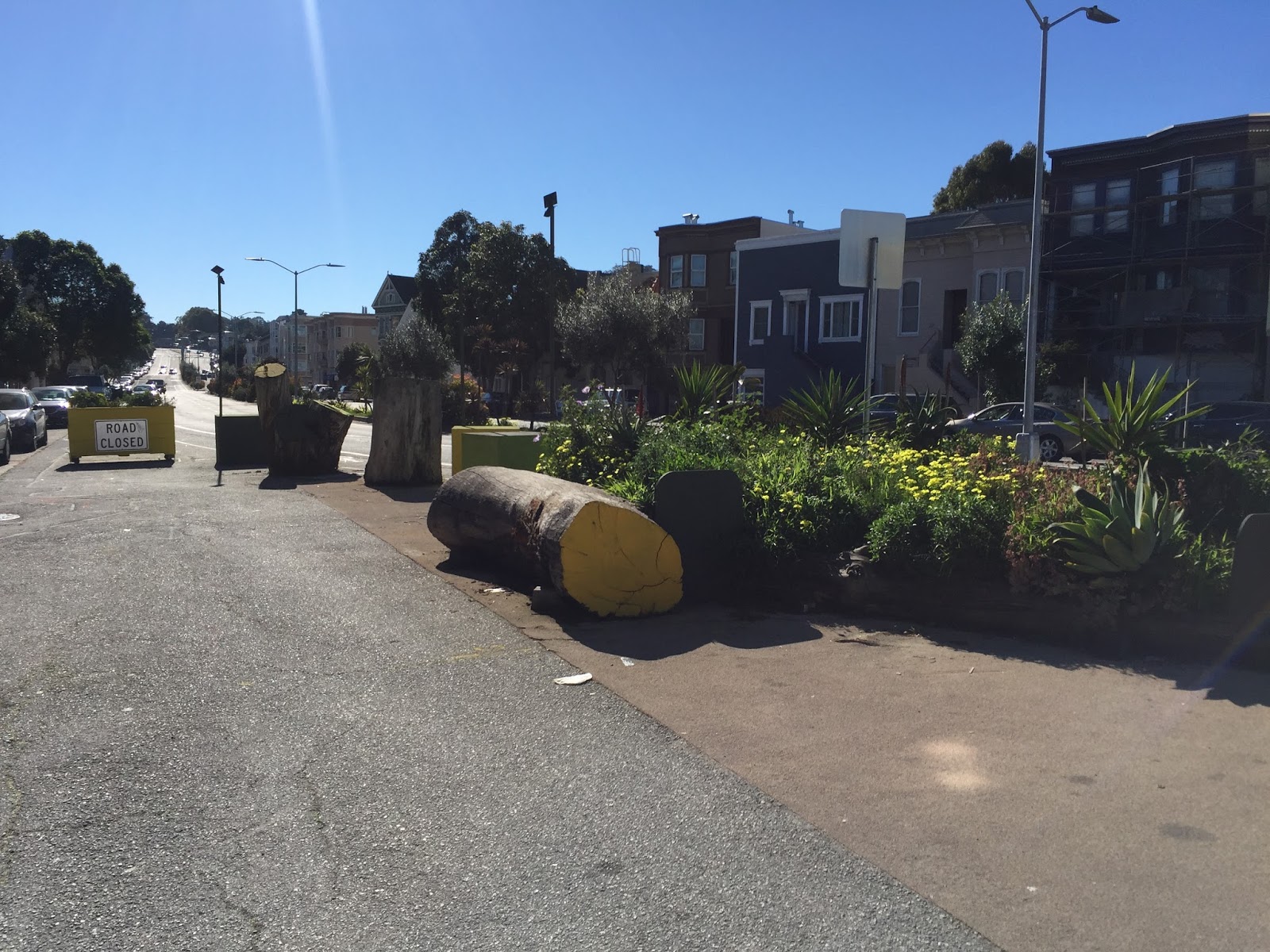
I've driven past this park on Guerrero countless times, and I finally got the chance to stop and experience it on a beautiful day (along with a Mitchell's treat :) This mini-park is somewhat like a dream! Once "inside" I learned that this plaza is part of a bigger project, Pavement to Parks, made possible by a collaboration between the mayor's office, the SF Planning Department, SFMTA, and Public Works. This is the kind of stuff I hope to be able to design in the future. 

BEFORE
Today: Looking north
Looking south
Sunny space to lay
Or sit
San Jose & 28th
Public Art
Left side looking north up Guerrero; right side looking south

Sunday, January 31, 2016

Design for Walkability

I stumbled across a SPUR Report from 2013 on how to strengthen San Jose's future through urban design. For my own notes, I would like to go over the first part of the report that introduces the importance of design in cities. 

What is Urban Design?
  • "the physical organization of buildings, streets and open spaces into whole places that work for people."
What does Urban Design address?
  • The placement, orientation and form of buildings
  • Site planning, or the physical arrangement of buildings and uses within development projects
  • Multiple scales, from the human body to the neighborhood or district
  • Circulation and access for all travel modes
  • Human experience, activity, social interaction and travel behavior
  • The arrangement and design of streets and open spaces
  • The connection of buildings to the public realm and to one another
  • Above all: the integration of these things
The Case for Walkable Urbanism
  • Sustainability
  • Mobility and Access
  • Prosperity and Economic Growth
  • Public Life
  • Public Health
  • Social Equity

Design for Walkability: Seven Key Components
  1. Create fine-grained pedestrian circulation
    • frequent and densely interconnected pedestrian routes that shorten both actual and perceived distances 
    • smaller city blocks are good examples
  2. Orient buildings to streets and open space
    • buildings should be placed right at the edges of streets and public spaces, not set back
  3.  Organize uses to support public activity
    •  active use of space, for example retail, should be along pedestrian routes, and private spaces should be tucked away
    • residential entrances should provide a graceful transition from public to private
  4. Place parking behind or below buildings 
    • parking is an expensive, space-hungry, and unattractive use and should be located to support and enliven public spaces
  5. Address the human scale with buildings and landscape details
    • people experience the built environment at the scale of their own bodies in space, and buildings should meet and engage people at that scale
  6. Provide clear, continuous pedestrian access
    • sidewalks are the city's connective tissue and should include elements like trees, lighting, street furniture and public art
  7. Build Complete Streets (from the National Complete Streets Coalition, Smart Growth America)
    • "A Complete Street provides safe, comfortable, attractive, and convenient access and travel for pedestrians, bicyclists, motorists, and transit users of all ages, abilities, and preferences. The design of a Complete Street considers both the public right-of-way and the land uses and design of the adjoining properties, including appropriate building heights and the planning of adjoining land uses that actively engage the public street realm."
 ____
This information is adapted from the 12/2013 SPUR Report, "Getting to Great Places: How better urban design can strengthen San Jose's future." 

Tuesday, January 26, 2016

Recap: Housing the Millennial Generation

As a Millennial who moved to the country's most expensive city a year ago, it only made sense to attend SPUR's forum last week on "Housing the Millennial Generation." Speaker Jed Kolko is an urban economist from UC Berkeley's Terner Center for Housing Innovation. He jam-packed a ton of data-heavy information into an amazingly coherent presentation, and I will outline the takeaways.

Millennial housing myths:
1. Millennials are driving today's housing demand.
2. Demographics don't explain Millennial housing behaviors.
3. Millennials are more urban than previous generations.

Reality:
1. Millennials are not driving today's housing demand.
2. Demographics explain Millennial housing behaviors.
3. Millennials are less urban than previous generations.

What it means:
  • Since demographics explain Millennial housing behaviors, it's not attitudes.
  • Household formation and home ownership may have permanently shifted later in life.
  • Housing investments must reflect seniors' preferences and needs.
  • Absent major policy shifts, there will be plenty of demand for suburban homes.
The key takeaway for me: It's SO easy to overlook demographics. But the people that makeup our nation can be one of the strongest forces and contribute immensely to shaping the world around us. 

inman / SF Bay Area

Check out Jed Kolko's website and more related posts like "Why Millennials Still Live With Their Parents."

Wednesday, January 20, 2016

The Yard at Mission Rock

Last month at a SPUR forum entitled Activating San Francisco's Southeast Waterfront, I learned more about the history and current activity in this unique part of the city. I do know a few things about this area, as my best friend works at a restaurant off 3rd and 16th Streets. First, it doesn't really feel like San Francisco. The streets are wider, it lacks car and people traffic, and empty lots, parking lots, and big commercial style buildings are common. It doesn't feel walkable, especially absent storefronts and housing - I kind of feel like an ant walking around in a giant maze-park when I'm here, and this doesn't happen often in this city. Part of this may be due to the spot's shipyard history, or maybe because of the large UCSF/Mission Bay campus. Nonetheless, I will definitely agree with SPUR that this tiny 1-mile stretch of SF will blow up in the coming years. Based on proximity alone, but also with the Warriors Stadium going up at the 3rd and 16th Street intersection, and being connected to the waterfront as well as MUNI, this place has a lot of potential. 

The point of this post, though, was to draw special attention to the Yard at Mission Rock, a "pop-up shipping container village" located in this neighborhood across the water from AT&T Park. The space is a "unique neighborhood gathering spot created out of repurposed shipping containers to provide daily shopping, food and beverage & cultural and community events." This concept curiously reminded me of my experience at Papirøen, a "public space experiment" in Copenhagen, Denmark. Much like Papirøen, a re-purposed public space that once served as paper storage, the "Yard" at Mission Rock once housed shipping containers. I think it's a beautiful comparison and more importantly an incredible idea to conduct an "experiment" that draws people to a place that was formerly off-limits or separate from the public. It's a chance to use the space without much planning or construction, and to quite literally experiment with how people interact with and feel about a space. Whether the space will turn into something else, time will tell, but for now it's a great way to make use of it! 
 
It's quiet today, but I bet it's poppin' on game day.

HUGE parking lot at the old Port of SF

Eat, drink, socialize, rest.

Welcoming space facing the ball park.

Step across the street to China Basin to get next to the water.


Wide streets...lots of potential :)


Pano!

Wednesday, November 25, 2015

Spotted: People, 1, Cars, -1

This post expands on one of my earlier posts. Since I came across the first "Pavement to Park", I can't stop noticing them everywhere across San Francisco...I absolutely love it! 
Mojo Cafe, Divisadero St
Pizzeria Delfina, California & Fillmore
My goal is to capture each one I pass by and add it to this post!

Wow! According to this NY Times article 'When the Parking Space Becomes a Park,' there are 51 of these "parks" around San Francisco, as of January 2015. One restaurant owner in the North Beach neighborhood has seen his business quadruple after installing one outside, so I'm betting more of these have popped up since the beginning of this year. According to the article, the idea originated in San Francisco with an arts collective, in order to challenge the automobile-centered approach to urban planning and design. And now, an international day on behalf of this idea has sprung up, called Park(ing) Day. 

Interestingly enough, the parklet I originally photographed is featured in the NY Times article with the co-founders standing in front of the 1973 Citroën H van, once used during the Tour de France. A few of the co-founders now head the San Francisco Gehl Studios (more about Jan Gehl in an older post).

A final glorious detail from the article. The original experiment in 2005 was considered a success after igniting human connection; after wandering onto the temporary parking-spot-turned-park and deciding the space was worthy enough to feed the meter, two strangers engaged in a spontaneous conversation.

Connection is beautiful!

____

Source
The New York Times

Tuesday, November 3, 2015

Measuring the Health Effects of Sprawl


Smart Growth America  published the first national study to establish a direct association between the form of the community and the health of the people who live there... over a decade ago. The report that was also covered by BBC, the New York Times, USA Today, and NPR confirms the adverse relationship between urban sprawl and physical activity, obesity, and morbidity. The results are not surprising. Here's what we found out:

    • people living in counties marked by sprawling development are likely to walk less and weigh more than people who live in less sprawling counties
    • sprawling counties are more likely to suffer from high blood pressure
    • the results hold true for factors of age, education, gender, race, ethnicity
    • people in sprawling areas are missing out on significant health benefits that are available simply by walking, biking, climbing stairs, and being active as a part of everyday life
    • 55 percent of Americans would like to walk more instead of driving;
    • 52 percent would like to bike more


      Now, onto the shocking part: We've been building, are building, and will continue to build communities - and not just ex-urban, but places we classify as cities - that prove detrimental to our health (think of many southeastern cities, like Atlanta). Instead we should be putting limits to our growth and thinking about maximizing space and becoming as efficient as possible. There are several reasons to do so besides the health benefits; less reliance on automobiles as well as the non-renewable fuel sources that come with transportation, conservation and preservation of land and habitat, the ability to create a more localized economy, closer-knit communities, etc. For starters that means less parking lots which is essentially dead space that promote driving. It's alarming that in some cities parking space covers a third of the land area, becoming such a dominant feature of our built environment that it has started to define it. Such dull environments obstruct our motivation and creativity. Limiting growth also means establishing city limits, mixed-use zoning regulations, transit-oriented development, narrow streets, and not just dense but compact development.

      While American cities may not have much on our European counterparts, below are the 10 cities with the largest share of their populations in functional urban cores (most compact), and they may compare the closest. It wouldn't come as a surprise if some of these cities were also the most fit.
       

      1. New York City (97.3 percent)
      2. Buffalo (94.5 percent)
      3. San Francisco (94.0 percent)
      4. Boston (89.7 percent)
      5. Hartford (87.4 percent)
      6. Providence (86.5 percent)
      7. St. Louis (84.1 percent)
      8. Minneapolis (83.5 percent)
      9. District of Colombia (83.4 percent)
      10. Philadelphia (83.4 percent)


      These should be the years for compact growth, urban infill, core renewal. How much containment and smart growth is possible? Hopefully the possibilities are not endless - at least spatially. But it all starts with a plan. 

      _________

      Sources & Links:

      Tuesday, October 27, 2015

      Social Capital

      Investing in PEOPLE. 

      In my opinion, this is one of the most important things we can do; as individuals (investing in yourself), as families, neighborhoods, communities, cities... all the way up to a national and even global level. 

      I like to think of social capital in my own way as the collective qualities of people in a community, as a result of the ability to have their basic needs met and access quality care - ultimately enabling them to prosper and propel their community and economy forward in a positive way. But "social capital" doesn't come from nothing; it takes time to establish and there are essential components that build social capital.

      Meeting basic needs (housing, food, shelter, etc., refer to an older post) but also creating equal and plentiful (and free) opportunities for quality healthcare and education, are just some key ingredients that build social capital. I also believe you can take it a step further and say that in order to maximize social capital, there needs to be a connecting and trusting relationship between the people and the governing system. So in difficult times or times of crisis, people feel secure and trust that their basic needs will be met by the system that's designed to support them - this encourages a level of comfort that allow people to take risks and those circumstances help churn out possibilities for a better society. 

      When people do not have good access to, for example, clean drinking water, many other important aspects of their life come to a pause because they're forced to revert back to using some of our most basic human instincts to simple get by. Staying alive and healthy, feeling secure and free from danger will certainly become before more skillful achievements. So, social capital cannot be improved when people and communities are stagnant in this tier, instead it will dumb down communities. And on larger scales, whether we are aware of it or not, these affects will be felt across society, furthering inequality.


      These ideas were sparked by an article I read by AECOM's Chief Sustainability Officer, mentioning the 3 types of capital and the current challenges we face with integrating them. The other forms of capital, natural capital (Earth's resources) and financial capital, along with social capital, are essential to each of our lives every single day. Author Gary Lawrence makes the most important point:
      "In stark contrast [to natural and financial capital,] the only natural resource that actually improves through use rather than being diminished is human capital. The inventiveness, intellectual ingenuity and diversity of our species are unique to Homo sapiens as far as we know. When the human mind is given the space to be curious and the opportunity to explore, great things become possible. This does not happen when the mind is occupied with feeding and sheltering the human body, scraping a subsistence living from day to day."
      Sometimes it's easy to get caught up in managing and protecting natural and financial capital when it's really the human aspect that we need to absolutely secure. Because in order to effectively manage our resources and external challenges, we need to have the knowledge base built and capacity to do so intelligently, and of course always with future generations in mind.

      _________

      Thursday, October 22, 2015

      "Shut Up and Listen!"

      Since the advent of what we term "modern" and/or professional urban planning around the 1900's, it's clear that it may miss the point of what it's designed to do: plan for people. In my humble opinion, I believe this is partly because of a population explosion; before large cities we had towns and small villages - connected communities of people that, to a certain extent knew each other and worked for or with each other. As populations expanded, degrees of separation began to build between people, and we kind of forgot the most important element of all: each other. 

      Dr. Sirolli is one of my Dad's friends who believes in a "person-centered approach to community and economic development," and he's been very successful with this. While it is not directly related to city planning, the messages he brings fourth are.

      We must shut and up and listen. Listen to our family, friends, neighbors, co-workers; listen to our community. That's it. And yet while it seems simple, it's not easy. 

      Dr. Sirolli makes another interesting point, he says that there is a problem with community meetings. "Entrepreneurs never come, and they never tell you, in a public meeting, what they want to do with their own money, what opportunity they have identified. So planning has this blind spot. The smartest people in your community you don't even know, because they don't come to your public meetings." This idea then, that Dr. Sirolli has capitalized on, has been to create a social infrastructure that hasn't existed previously, learning how to get people to come and talk to him and ultimately helping them based on their needs.

      Some people might be wondering "well, what does this have to do with planning cities?" While in some ways, connecting entrepreneurs with a community's future brings the conversation to another level, at a basic level I can extract what's most important: Listening to communities, and not just communities, but individual people. Planners and community leaders shouldn't be there to direct but rather to connect, empathize, strategize, and represent. This builds trust, strong communities, even friendships.

      In recent years it seems that there's been paradigm shift, putting the focus on the people of communities, with trail runs and experiments that involve everyone or "I Wish This Was" sticker campaigns


      Final words from Dr. Sirolli's TED Talk:
      "What we have to look at is at how we feed, cure, educate, transport, communicate for seven billion people in a sustainable way. The technologies do not exist to do that. Who is going to invent the technology for the green revolution? Universities? Forget about it! Government? Forget about it! It will be entrepreneurs, and they're doing it now."
      __________

      Links/sources:

      Dr. Sirolli's TED Talk
      Strategy and Business article about Dr. Sirolli
      History of Urban Planning Wikipedia