Showing posts with label street design. Show all posts

Sunday, February 28, 2016

Less Road, More Space

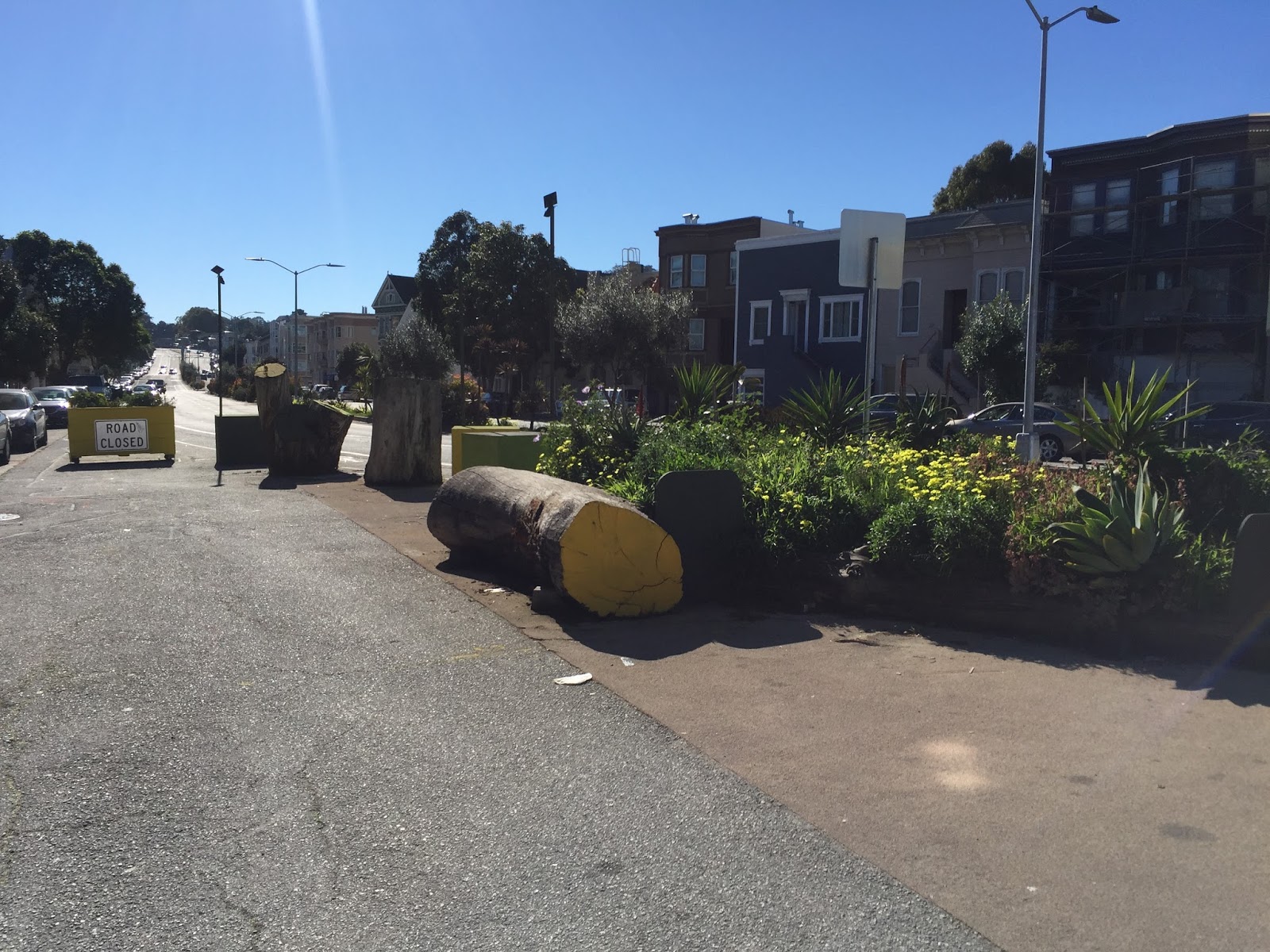
I've driven past this park on Guerrero countless times, and I finally got the chance to stop and experience it on a beautiful day (along with a Mitchell's treat :) This mini-park is somewhat like a dream! Once "inside" I learned that this plaza is part of a bigger project, Pavement to Parks, made possible by a collaboration between the mayor's office, the SF Planning Department, SFMTA, and Public Works. This is the kind of stuff I hope to be able to design in the future. 

BEFORE
Today: Looking north
Looking south
Sunny space to lay
Or sit
San Jose & 28th
Public Art
Left side looking north up Guerrero; right side looking south

Tuesday, October 13, 2015

Lessons in Walking & Cycling from Western Europe

Most of the cities in the United States evolved alongside and/or took off because of the automobile. Cities were planned and built with the car as the main mode of transportation; suburbs made possible thanks to cars. As a result we get wider streets, bigger blocks, lower density; whole metropolis areas that are excruciatingly spread out. This leads to the destruction of natural land and habitats, unsustainable development, and quite frankly it's just a waste that generates physical inefficiency on a massive scale.

European cities have been around much longer, and developed much of their infrastructure prior to the automobile being a widespread mode of transit. This is why Europe boasts cities with some of the best public transportation systems in the world. Railways were built beginning in the mid 19th century, but you can imagine before that it was just smaller dirt roads for walking and eventually horses. Early settlements weren't formally planned, rather they would have evolved on a needs basis based on accessibility by foot. Hence, comparing typical European and American cities might look like this (source):


It's no wonder that European city residents walk and bike so much more - everything is relatively close together. Few US cities use space similarly to their European counterparts - New York City, San Francisco, Boston would be the closest examples. I was thrilled to find an article comparing walking and biking trends between these places, with of course a focus on the countries that do it exceptionally well: the Netherlands, Denmark, and Germany. I pulled some great visuals from the article to check out. 


Walking and even more so biking in most US cities is simply unsafe. In addition to infrastructure that is built for and around cars, our brains and habits have been wired for driving. We've adapted to car-centric environments that largely don't incorporate any other form of transit at all, depending on where we are. Feeling safe - and knowing that our loved ones are safe - while traveling from home to school or work is probably the biggest factor in choosing a mode of transportation. If we don't have confidence in getting from point A to point B by foot or bike in a reliable manner, we won't do it. Yet ironically enough, cars are far more dangerous to life. This disconnect between perception and reality only exists because of the type of physical environment we've built and continue to build today. The good news is that many American cities are starting to catch on to opening streets to more than just cars.

Countries home to bicycle-friendly cities like Amsterdam, Copenhagen, and Berlin, where a third or even up to half of the people commute by bike, have far fewer casualties and injuries when compared to the US where a measly 3 percent travel by bike. This is a difference in infrastructure as well as habits and behavior. It is also convincing that as more people hop on their bikes, the safer the commute will become. This very trend of the "safety in numbers" has taken place in Denmark and Germany.


The article cites a number of strategies that have worked well in European cities and can encourage more walking and cycling in the US. This includes cracking down on safety; policies that promote walking and cycling but also restrict car use like auto-free zones. Bike infrastructure can look different depending on the place as long as it includes elements of comfort and safety, clearly marked bike lanes or separate paths, allowing width for more sociable rides. Right-of-ways and separate bike traffic signals, or even cycle super highways like this new one in Copenhagen, called the "Cykelslangen" or "cycle snake." Additional techniques for more biking and walking include traffic calming, integrating these trips with other methods of public transit, compact mixed-use development, introducing these concepts from an early age, more training, traffic regulations, and broader policies like road capacity, limiting park spaces, and taxes on cars and fuel. Finally it's necessary to keep in mind that a combination of techniques are needed to have successful rates of walking and biking, and no one strategy should be used. American cities have a few fantastic models, but we shouldn't expect to get the same results by duplicating something else. Each city must formulate what will work best for its people, because only those people come first... and last!


Sources:
The New Climate Economy / Chapter on Cities
Transportation Research News / Walking and Cycling in Western Europe and the US 

Another interesting opinion:
Yale Environment 360 / On Biking, Why Can't the US Learn Lessons from Europe 

Friday, October 9, 2015

Germany: Learning the Rules of the Road in Primary School

Last year during my extended stay just outside Munich, Germany, I came across the following:


It may be difficult to see the scale in the picture, but it's an enclosed mini-road system where children learn the safety standards for cycling. The schools in this town of Vaterstetten require that students pass a test, ensuring that the streets stay consistent with safety and sharing the road. The test is given in primary school, more than a full decade before Germans are able to obtain a driving license. Getting a license in Germany as well as Denmark is expensive and time-consuming. My cousin Lara in Munich and host-sisters Jose/Emma in Copenhagen likely paid upwards of $2,000 USD and spent more than 50 hours for theory and professional instruction for a license. And more than often a license does not come with a car; this is also incredibly expensive in these countries. I will grab some numbers from copenhagenize.com
In Denmark a basic compact car will cost you about 100,000 DKK. ($17,400). A new Honda, depending on model, will cost between 200,000 DKK ($34,700 USD) and 500,000 DKK ($86,900). A new BMW, again depending on model, will set you back between 400,000 DKK ($69,500 USD) and 2.5 million DKK ($434,360 USD).
And finally, fuel prices. The price per gallon of gasoline is nearly triple in Germany and Denmark, compared with the US. Currently the US average is $2.32 per gallon; $6.07/gallon in Germany; $6.34/gallon in Denmark. 

I will end on this statistic (found once again on copenhagenize.com):
Bicycle: 63 cents net profit for society. (3.65 DKK)  
Car: $1.15 net loss to society. (6.59 DKK)
And keep in mind, this is in Denmark, without the massive subsidies for autos and fuel.

WOW. Maybe we should be building mini-roads to train and test our children for cycling in this country, and better bicycle infrastructure to go along with it! Cycling is beneficial in sooo many ways... 

Saturday, September 19, 2015