Showing posts with label cities for people. Show all posts

Sunday, February 28, 2016

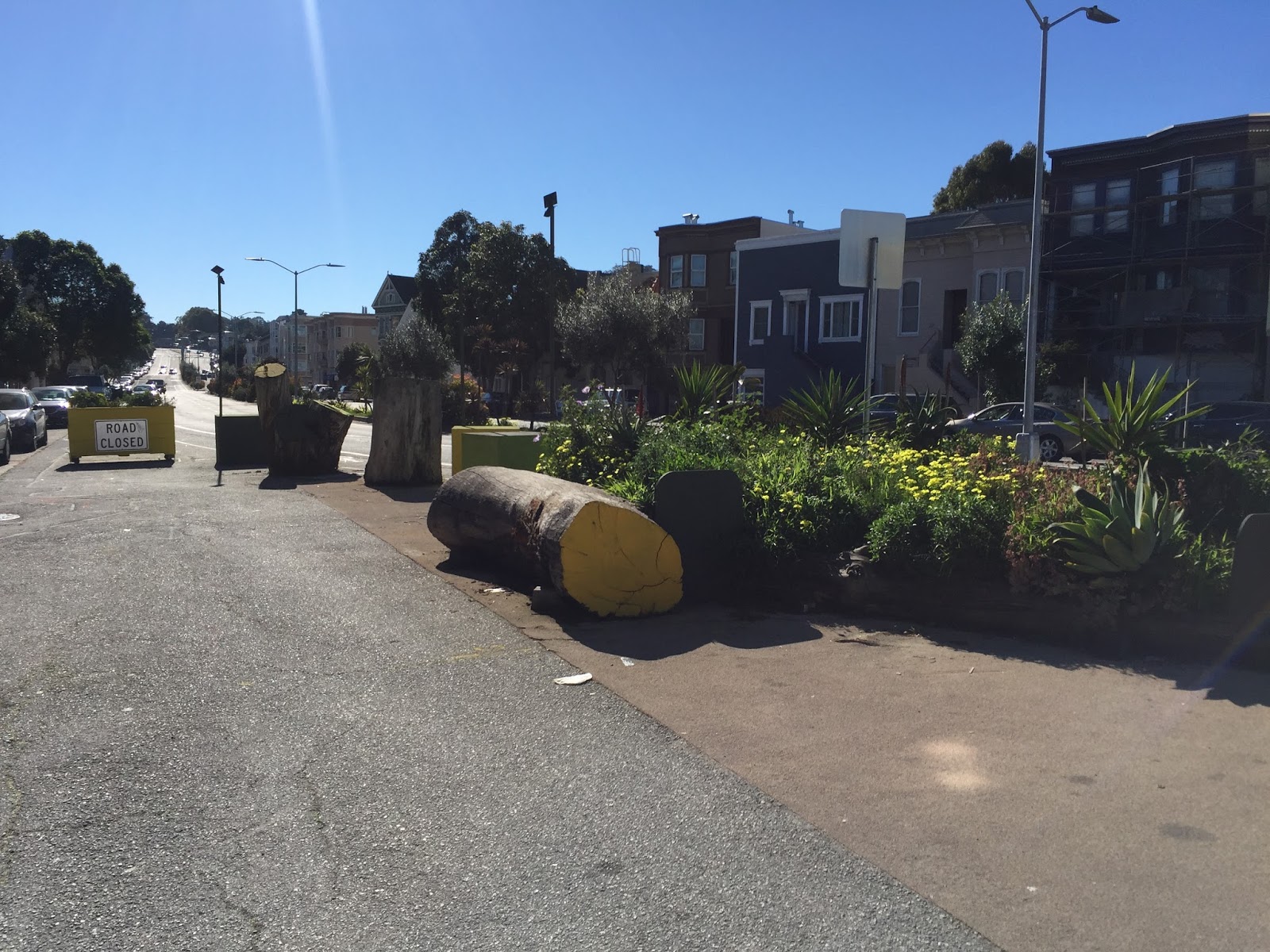
Less Road, More Space

I've driven past this park on Guerrero countless times, and I finally got the chance to stop and experience it on a beautiful day (along with a Mitchell's treat :) This mini-park is somewhat like a dream! Once "inside" I learned that this plaza is part of a bigger project, Pavement to Parks, made possible by a collaboration between the mayor's office, the SF Planning Department, SFMTA, and Public Works. This is the kind of stuff I hope to be able to design in the future. 

BEFORE
Today: Looking north
Looking south
Sunny space to lay
Or sit
San Jose & 28th
Public Art
Left side looking north up Guerrero; right side looking south

Sunday, January 31, 2016

Design for Walkability

I stumbled across a SPUR Report from 2013 on how to strengthen San Jose's future through urban design. For my own notes, I would like to go over the first part of the report that introduces the importance of design in cities. 

What is Urban Design?
  • "the physical organization of buildings, streets and open spaces into whole places that work for people."
What does Urban Design address?
  • The placement, orientation and form of buildings
  • Site planning, or the physical arrangement of buildings and uses within development projects
  • Multiple scales, from the human body to the neighborhood or district
  • Circulation and access for all travel modes
  • Human experience, activity, social interaction and travel behavior
  • The arrangement and design of streets and open spaces
  • The connection of buildings to the public realm and to one another
  • Above all: the integration of these things
The Case for Walkable Urbanism
  • Sustainability
  • Mobility and Access
  • Prosperity and Economic Growth
  • Public Life
  • Public Health
  • Social Equity

Design for Walkability: Seven Key Components
  1. Create fine-grained pedestrian circulation
    • frequent and densely interconnected pedestrian routes that shorten both actual and perceived distances 
    • smaller city blocks are good examples
  2. Orient buildings to streets and open space
    • buildings should be placed right at the edges of streets and public spaces, not set back
  3.  Organize uses to support public activity
    •  active use of space, for example retail, should be along pedestrian routes, and private spaces should be tucked away
    • residential entrances should provide a graceful transition from public to private
  4. Place parking behind or below buildings 
    • parking is an expensive, space-hungry, and unattractive use and should be located to support and enliven public spaces
  5. Address the human scale with buildings and landscape details
    • people experience the built environment at the scale of their own bodies in space, and buildings should meet and engage people at that scale
  6. Provide clear, continuous pedestrian access
    • sidewalks are the city's connective tissue and should include elements like trees, lighting, street furniture and public art
  7. Build Complete Streets (from the National Complete Streets Coalition, Smart Growth America)
    • "A Complete Street provides safe, comfortable, attractive, and convenient access and travel for pedestrians, bicyclists, motorists, and transit users of all ages, abilities, and preferences. The design of a Complete Street considers both the public right-of-way and the land uses and design of the adjoining properties, including appropriate building heights and the planning of adjoining land uses that actively engage the public street realm."
 ____
This information is adapted from the 12/2013 SPUR Report, "Getting to Great Places: How better urban design can strengthen San Jose's future." 

Wednesday, November 25, 2015

Spotted: People, 1, Cars, -1

This post expands on one of my earlier posts. Since I came across the first "Pavement to Park", I can't stop noticing them everywhere across San Francisco...I absolutely love it! 
Mojo Cafe, Divisadero St
Pizzeria Delfina, California & Fillmore
My goal is to capture each one I pass by and add it to this post!

Wow! According to this NY Times article 'When the Parking Space Becomes a Park,' there are 51 of these "parks" around San Francisco, as of January 2015. One restaurant owner in the North Beach neighborhood has seen his business quadruple after installing one outside, so I'm betting more of these have popped up since the beginning of this year. According to the article, the idea originated in San Francisco with an arts collective, in order to challenge the automobile-centered approach to urban planning and design. And now, an international day on behalf of this idea has sprung up, called Park(ing) Day. 

Interestingly enough, the parklet I originally photographed is featured in the NY Times article with the co-founders standing in front of the 1973 Citroën H van, once used during the Tour de France. A few of the co-founders now head the San Francisco Gehl Studios (more about Jan Gehl in an older post).

A final glorious detail from the article. The original experiment in 2005 was considered a success after igniting human connection; after wandering onto the temporary parking-spot-turned-park and deciding the space was worthy enough to feed the meter, two strangers engaged in a spontaneous conversation.

Connection is beautiful!

____

Source
The New York Times

Tuesday, October 27, 2015

Social Capital

Investing in PEOPLE. 

In my opinion, this is one of the most important things we can do; as individuals (investing in yourself), as families, neighborhoods, communities, cities... all the way up to a national and even global level. 

I like to think of social capital in my own way as the collective qualities of people in a community, as a result of the ability to have their basic needs met and access quality care - ultimately enabling them to prosper and propel their community and economy forward in a positive way. But "social capital" doesn't come from nothing; it takes time to establish and there are essential components that build social capital.

Meeting basic needs (housing, food, shelter, etc., refer to an older post) but also creating equal and plentiful (and free) opportunities for quality healthcare and education, are just some key ingredients that build social capital. I also believe you can take it a step further and say that in order to maximize social capital, there needs to be a connecting and trusting relationship between the people and the governing system. So in difficult times or times of crisis, people feel secure and trust that their basic needs will be met by the system that's designed to support them - this encourages a level of comfort that allow people to take risks and those circumstances help churn out possibilities for a better society. 

When people do not have good access to, for example, clean drinking water, many other important aspects of their life come to a pause because they're forced to revert back to using some of our most basic human instincts to simple get by. Staying alive and healthy, feeling secure and free from danger will certainly become before more skillful achievements. So, social capital cannot be improved when people and communities are stagnant in this tier, instead it will dumb down communities. And on larger scales, whether we are aware of it or not, these affects will be felt across society, furthering inequality.


These ideas were sparked by an article I read by AECOM's Chief Sustainability Officer, mentioning the 3 types of capital and the current challenges we face with integrating them. The other forms of capital, natural capital (Earth's resources) and financial capital, along with social capital, are essential to each of our lives every single day. Author Gary Lawrence makes the most important point:
"In stark contrast [to natural and financial capital,] the only natural resource that actually improves through use rather than being diminished is human capital. The inventiveness, intellectual ingenuity and diversity of our species are unique to Homo sapiens as far as we know. When the human mind is given the space to be curious and the opportunity to explore, great things become possible. This does not happen when the mind is occupied with feeding and sheltering the human body, scraping a subsistence living from day to day."
Sometimes it's easy to get caught up in managing and protecting natural and financial capital when it's really the human aspect that we need to absolutely secure. Because in order to effectively manage our resources and external challenges, we need to have the knowledge base built and capacity to do so intelligently, and of course always with future generations in mind.

_________

Thursday, October 22, 2015

"Shut Up and Listen!"

Since the advent of what we term "modern" and/or professional urban planning around the 1900's, it's clear that it may miss the point of what it's designed to do: plan for people. In my humble opinion, I believe this is partly because of a population explosion; before large cities we had towns and small villages - connected communities of people that, to a certain extent knew each other and worked for or with each other. As populations expanded, degrees of separation began to build between people, and we kind of forgot the most important element of all: each other. 

Dr. Sirolli is one of my Dad's friends who believes in a "person-centered approach to community and economic development," and he's been very successful with this. While it is not directly related to city planning, the messages he brings fourth are.

We must shut and up and listen. Listen to our family, friends, neighbors, co-workers; listen to our community. That's it. And yet while it seems simple, it's not easy. 

Dr. Sirolli makes another interesting point, he says that there is a problem with community meetings. "Entrepreneurs never come, and they never tell you, in a public meeting, what they want to do with their own money, what opportunity they have identified. So planning has this blind spot. The smartest people in your community you don't even know, because they don't come to your public meetings." This idea then, that Dr. Sirolli has capitalized on, has been to create a social infrastructure that hasn't existed previously, learning how to get people to come and talk to him and ultimately helping them based on their needs.

Some people might be wondering "well, what does this have to do with planning cities?" While in some ways, connecting entrepreneurs with a community's future brings the conversation to another level, at a basic level I can extract what's most important: Listening to communities, and not just communities, but individual people. Planners and community leaders shouldn't be there to direct but rather to connect, empathize, strategize, and represent. This builds trust, strong communities, even friendships.

In recent years it seems that there's been paradigm shift, putting the focus on the people of communities, with trail runs and experiments that involve everyone or "I Wish This Was" sticker campaigns. 


Final words from Dr. Sirolli's TED Talk:
"What we have to look at is at how we feed, cure, educate, transport, communicate for seven billion people in a sustainable way. The technologies do not exist to do that. Who is going to invent the technology for the green revolution? Universities? Forget about it! Government? Forget about it! It will be entrepreneurs, and they're doing it now."
__________

Links/sources:

Dr. Sirolli's TED Talk
Strategy and Business article about Dr. Sirolli
History of Urban Planning Wikipedia

Tuesday, October 20, 2015

Repost: Saint Paul reveals exciting plans for river balcony park


On September 24, Saint Paul Mayor Coleman presented the city's latest vision to improve the connections between the Mississippi River and downtown Saint Paul while improving the parkland and connections along the river between the Science Museum and the Union Depot. The current vision and model show exciting new features including additional linear and vertical trails, community gathering spaces, market spaces, a restaurant, a dock that welcomes people to the city though Union Depot and more.

This vision of reconnecting downtown Saint Paul to the Mississippi River has grown out of the 2011 Saint Paul Great River Passage Plan. That plan calls for:

  • overlooks, and public stairs and elevators at buildings and bridges along the bluff 
  • a series of outdoor rooms with panoramic views
  • a great year-round destination for shopping, lunch or to relax with friends after a concert of sporting event
  • daily lunchtime visitors and early evening entertainment programming
  • a great streetscape that supports stronger pedestrian connections into Downtown, and a place in the Grand Round system.
While enthusiasm for the river balcony project is high, both the Mayor and city staff have been frank about the fact that this project is not expected to be completed in five or even 10 years. They have stressed that it is something that will evolve over the many coming years. Despite the long timeline, FMR finds it heartening that the city continues to plan for and work toward reconnecting with the Mighty Mississippi River--a feature that was long ignored and used as a dump.

_______________


This is a repost from Friends of the Mississippi River News, October 12, 2015 by Alicia Uzarek

Tuesday, October 13, 2015

Lessons in Walking & Cycling from Western Europe

Most of the cities in the United States evolved alongside and/or took off because of the automobile. Cities were planned and built with the car as the main mode of transportation; suburbs made possible thanks to cars. As a result we get wider streets, bigger blocks, lower density; whole metropolis areas that are excruciatingly spread out. This leads to the destruction of natural land and habitats, unsustainable development, and quite frankly it's just a waste that generates physical inefficiency on a massive scale.

European cities have been around much longer, and developed much of their infrastructure prior to the automobile being a widespread mode of transit. This is why Europe boasts cities with some of the best public transportation systems in the world. Railways were built beginning in the mid 19th century, but you can imagine before that it was just smaller dirt roads for walking and eventually horses. Early settlements weren't formally planned, rather they would have evolved on a needs basis based on accessibility by foot. Hence, comparing typical European and American cities might look like this (source):


It's no wonder that European city residents walk and bike so much more - everything is relatively close together. Few US cities use space similarly to their European counterparts - New York City, San Francisco, Boston would be the closest examples. I was thrilled to find an article comparing walking and biking trends between these places, with of course a focus on the countries that do it exceptionally well: the Netherlands, Denmark, and Germany. I pulled some great visuals from the article to check out. 


Walking and even more so biking in most US cities is simply unsafe. In addition to infrastructure that is built for and around cars, our brains and habits have been wired for driving. We've adapted to car-centric environments that largely don't incorporate any other form of transit at all, depending on where we are. Feeling safe - and knowing that our loved ones are safe - while traveling from home to school or work is probably the biggest factor in choosing a mode of transportation. If we don't have confidence in getting from point A to point B by foot or bike in a reliable manner, we won't do it. Yet ironically enough, cars are far more dangerous to life. This disconnect between perception and reality only exists because of the type of physical environment we've built and continue to build today. The good news is that many American cities are starting to catch on to opening streets to more than just cars.

Countries home to bicycle-friendly cities like Amsterdam, Copenhagen, and Berlin, where a third or even up to half of the people commute by bike, have far fewer casualties and injuries when compared to the US where a measly 3 percent travel by bike. This is a difference in infrastructure as well as habits and behavior. It is also convincing that as more people hop on their bikes, the safer the commute will become. This very trend of the "safety in numbers" has taken place in Denmark and Germany.


The article cites a number of strategies that have worked well in European cities and can encourage more walking and cycling in the US. This includes cracking down on safety; policies that promote walking and cycling but also restrict car use like auto-free zones. Bike infrastructure can look different depending on the place as long as it includes elements of comfort and safety, clearly marked bike lanes or separate paths, allowing width for more sociable rides. Right-of-ways and separate bike traffic signals, or even cycle super highways like this new one in Copenhagen, called the "Cykelslangen" or "cycle snake." Additional techniques for more biking and walking include traffic calming, integrating these trips with other methods of public transit, compact mixed-use development, introducing these concepts from an early age, more training, traffic regulations, and broader policies like road capacity, limiting park spaces, and taxes on cars and fuel. Finally it's necessary to keep in mind that a combination of techniques are needed to have successful rates of walking and biking, and no one strategy should be used. American cities have a few fantastic models, but we shouldn't expect to get the same results by duplicating something else. Each city must formulate what will work best for its people, because only those people come first... and last!


Sources:
The New Climate Economy / Chapter on Cities
Transportation Research News / Walking and Cycling in Western Europe and the US 

Another interesting opinion:
Yale Environment 360 / On Biking, Why Can't the US Learn Lessons from Europe 

Tuesday, September 22, 2015

Design for Wellbeing in the Built Environment

My first post to this blog, almost one year ago now, focused on designing future environments for the wellbeing of its people. Today I will take it back to the topic with Professor Libby Burton's Legacy Lecture: The Pursuit of Happiness. I share many, if not all of Professor Burton's words in her video (below) - she is interested in creating environments that make people happy and help people flourish. I would like to review the key information from her 30-minute talk. 

People are starting to ask the question "How do the environments around us make us feel?" I believe that is one of the most important questions today, and I would like to help answer it. It's a new topic of interest that has emerged in recent years for a few reasons. Firstly, research concludes that health and health issues are lifestyle related. The classic example is of people being thinner and more heart healthy in cities or higher density areas. Also, physical health and mental health are equally important yet so intertwined. And finally, developing sustainably will only be successful if we first consider peoples needs and desires. The built environment plays the biggest role in these three facets. 

Well being is directly affected by the built environment in these ways:
  • Mood - the immediate world around us has considerable influence on our ever-changing outward and expressive moods
  • Feeling - how does this place make us feel on the inside
  • Stress levels and stress tolerance - a relaxing environment will help balance out high energy or stress levels
  • Functionality - does the environment serve its purpose and allow you to efficiently accomplish the task at hand?
  • Concentration - too many distractions can lead to a loss of focus
  • Coping with mental disorders - Libby uses the example of repetitive street patterns negatively impacting people with dementia 
  • Experience of pain
  • Physical discomfort (body temperature) and safety from injury 
  • Satisfaction with life - Libby uses the example of status of housing
The built environment affects us indirectly as well:
  • Physical activity
  • Social engagement and interaction, community spirit
  • Biophilia - human connection to nature and other living systems
  • Accessibility
  • Attachment and belonging - sense of place, uniqueness
  • Safety and security
  • Competence and accomplishment
  • Autonomy and independence
  • Equality
So far, this is what we know: 
  • Density encourages walking, social interaction and community engagement
  • Mixed-use, medium-rise, local facilities and amenities in an irregular grid pattern are the most functional
  • Greenery: as much as possible without sacrificing density
  • Transition zones: there should be soft edges between public and private space to encourage social interaction 
  • Housing layouts should offer a balance of communal and private space
  • "Eyes on the street:" plenty of windows towards the street to foster feelings of safety
  • Maximize day lighting
  • Clear differentiation between public and private space
  • Attractiveness of the environment
The smells and sounds of our immediate environments in cities help us gather and process information, but we are visually wired animals; almost 50 percent of our brain is involved in visual processing, 70 percent of all our sensory receptors are in our eyes, and we can get the sense of a visual scene in less than 1/10 of a second. That information forms short-term emotions that turn into lasting feelings with positive and negative impacts on our overall wellbeing. It's crucial that we carefully design our built environments for prolonged success. 


Click to see Libby Burton's Legacy Lecture

Wednesday, August 26, 2015

Twin City Rapid Transit

Yesterday I returned to SF from a short stay at "home" in St. Paul, Minnesota. Being with my family and friends certainly makes me feel the love for where I was born and raised, but I can't help compare the two places. I love it here, and while it's not the place where my "people" happen to be, it is the place where I don't spend 25% or more of my time in a car getting around from place to place, person to person. 

In celebration of the Twin Cities, I'm sharing this map from 1913 showing the "Rapid Transit" streetcars of Minneapolis and St. Paul. 


Timeline
1872: The first streetcars were pulled by horses, starting off in St. Paul
1875: The city of Minneapolis joins in
1887: Upgrades to the system allowed the cars to be pulled by cable loops
1892: Cars hit the electric grid
1920: Peak ridership occurred, carrying an estimated 238 million people
1929 - 1930's: The Great Depression saw ridership leveling off
1939 - 1945: There was a climb in passengers as World War II brought gas rationing
1954: The Twin Cities had its last streetcar journey in Minneapolis

The system stretched from Stillwater to Lake Minnetonka, with a total of 523 miles of streetcar!
The pink pin is Excelsior, on Lake Minnetonka. Stillwater in the northeast corner, located on the St. Croix River which separates Minnesota and Wisconsin here.

Is it ironic that streetcars in cities today are tourist attractions; we get entertainment out of these transportation units that are a thing of the past, yet technically speaking, very efficient? And had all the routes lasted longer, without the interfering competition from automobiles, they could have been a huge factor in the continued creation of what I imagine to be extraordinary urban and inter-urban transportation, spaces, and places. 

For example, San Francisco is famous for having streetcars that tourists will wait hours to ride. San Franciscans don't ride them unless you hop on to hop off, or, you find yourself in these situations: 


"These situations," being visits from family, are the best, by the way!

Even in Minnesota, we have a museum dedicated to our historic streetcar. Though they are a thing of the past in terms of getting people from point A to point B on a daily basis, I believe they will make a comeback by influencing future transportation services of the future!


Today in SF you find a convergence of the historical streetcar and a modern US city's bus system: buses that are (typically) connected to above electricity. The buses run absolutely everywhere, and are pretty reliable. Technology has helped with that :)


I didn't want to find something off the web, so I looked out my window and took one for myself! Notice the electric wires across the image; buses connect to these. Although an extensive bus system requires lots of energy, transportation connected to electricity reduces pollution, which is a concern in terms of air quality in denser cities.

Sources & Links:
MN Historical Society YouTube video 
Top 10 Trolly Rides
Minnesota History Center 
Minnesota Streetcar Museum

Tuesday, July 21, 2015

You Can't Park Here, But Please, Sit

This is a way of saying "this street/parking space is for PEOPLE!" To eat, drink, chat, hang out, lounge, relax! True creativity at its best.


Location: Cow Hollow, San Francisco, California

Wednesday, June 17, 2015

Healthly and Equitable Density

A recent post on CEOs for Cities from Stantec senior principle David Dixon entitled "To Make Your Community Healthier, Make It Denser" contains a number of meaty statistics about the connections between health, cars, equality, and cities... fueling the reality that density saves lives:
  •  1999: The Centers for Disease Control reported that inactivity and poor diet caused 300,000 deaths in the United States, second only to tobacco (CDC)
  •  2008: University of Utah researchers found that men who lived in walkable neighborhoods weighed 10 pounds less than men in low-density neighborhoods (NRDC)
  •  2014: Cities with more compact street networks have lower levels of obesity, diabetes, high blood pressure, and heart disease (Journal of Transport & Health)
  • Per-capita auto fatalities rise roughly 400 percent along a continuum of density from typical urban to typical suburban (Accident Analysis & Prevention)
  • The United States has three to five times the amount of traffic fatalities relative to other developed countries; auto fatalities represent the #1 cause of accidental deaths in the U.S. (Source)
  •  Ten percent of U.S. households control 75 percent of all U.S. wealth - the wealthy are consuming the walkable neighborhoods at a voracious rate. 
  • For the first time in this country's history, more poor people live in suburbs than in cities (Source) 


"The payback from density extends beyond physical health. Walkable neighborhoods promote economic health by attracting knowledge workers and investment and promote environmental health by creating an inviting alternative to sprawl... [Yet] as we employ density to create healthy neighborhoods, we also need to employ it to create equity."
 

Monday, May 18, 2015

Street Design Shapes Lifestyle


Picture this:

You live in the neighborhood on the left where the streets were designed with the passive approach. You have errands to run so you get in your car, driving from store to store, even though each store is located just a few hundred feet from each other. You get into your car, likely just to drive across the street and park in another massive and identical looking parking lot. Get out of your car, get back into your car, spend 5-10 minutes to travel .02 miles. Your errands take 2 or 3 hours out of your Saturday.

Or picture this:

You live in a "proactively-designed-streets" neighborhood, and you spend 5-20 minutes a day, stopping for your errands down the block as you walk home from work/school/etc.

What lifestyle sounds more appealing? Which is better for health, happiness, and what is easier on our natural resources?

________

Image adapted from the National Association of Transportation Officials Urban Street Design Guide

Saturday, May 2, 2015

The "End of the Car Age" and how technology makes it happen

A great article from the Guardian (thanks Scott Moen aka Dad!) about how many cities are transitioning away from cars. The article digs into a couple different facets, but I decided to highlight the link between the "end of the car age" and the "digital age," as it relates directly to me.

Digital technology will have a major role in creating collaborative platforms for urban mobility:
"Digital information is the fuel of mobility,” says Gilles Vesco, the politician responsible for the city of Lyon, France's sustainable transport. “Some transport sociologists say that information about mobility is 50% of mobility. The car will become an accessory to the smartphone."
"The more that we have people sharing transportation modes, public space, information and new services, the more attractive the city will be."
In order for cities to compete they will need to be increasingly interconnected and multi-modal: a variety of public transit and healthy lifestyle options that include bike-friendly roadways, cycle superhighways, bike-shares, car-shares, bus service, subways, trams, and increased walkability. This also means cities will need to focus on providing reliable technological infrastructure. Being well connected on a physical and city-wide scale is equally important today as being connected on a digital scale. All which will lessen car-dependence and make owning a private automobile inconvenient relative to the variety of options that are readily available at our fingertips and often times free (transit apps for smartphones) or less expensive.
"Generation Y, or millennials, now in their 20s and early 30s who have come of age in the digital era, seem less wedded to possessions than their baby boomer predecessors. Smartphones are prized objects and the future of transport is likely to be based not on individually owned cars but on “mobility as a service.” Consumers will, so the theory goes, use their smartphones to check ultra-detailed travel news, locate car-club cars or bikes, check for parking spaces, call up Uber drivers, and arrange shared rides. Who needs a personally owned car?"
This may be part of a "theory" of reality in general right now and as far as this article goes, but, on a daily basis I either walk, take a bus, request an Uber, check my real-time travel app, or locate and arrange a car club or share. I am living proof that this is happening right now.

Friday, May 1, 2015

Early Observations of San Francisco


It's hard to believe I visited San Francisco this past January 2015 before taking the real plunge in moving to the city the following month. I had been here once before in September 2011 for a tournament with my college soccer team (doesn't count, right?). Little did I know I would be back to stay, and so quick to fall in love with this place for so many reasons. The above picture was taken in January because I was so exited to finally be here and to start making observations on the minute details of the city that I have such an eye for. Unfortunately, I haven't had many pictures to follow this (hence my falling behind on intended posts). And there was also the whole "finding a place to live in the most expensive and housing-competitive city in the country" that was a distracting priority. It's almost as if I've stopped noticing many of the details that make this city amazing, and maybe that was okay too, because that's exactly what makes life in here that great. Natives or people who are accustomed to this lifestyle may not understand what makes this place tick. People who just experience living here shorter term question why they would ever leave and ask what was so wrong (different) about back home.
On a different note, that may be the best part: the chance to be and become a part of the routine, because I notice these things. I won't ever fail to recognize that I am living in what is quite possibly the closest to my dream world, every single day. These realizations have created the opportunity for me to be more conscious and mindful of what I do and see on a daily basis, with the goal of sharing my experiences here on this blog.

Some of my first observations of this city:
  • The "Green Wave" that has traffic signals set for 13 mph - the average speed of a bike. Convenience for bikes is favored over cars.  
  • The density. San Francisco is 7 miles by 7 miles. It's a growing city. Everything must be built close, in between, or on top of something else.
  • That makes it really easy to walk, bike, transit, etc. places (the most you would ever need to travel to get from one end of the city to the other is... 7 miles!)
  • Suburban sprawl doesn't and physically cannot exist. Therefore big box stores and parking lots do not exist (my biggest eyesores!)
  • Public transportation is almost too easy. So much variety! The electric buses are cool and it shows that the city cares about air pollution.
  • It's annoying and expensive to own a car here. Parking? Traffic? No thanks. 
  • Then again people love their benz and beamers...money. But there are also many homeless people - the whole range is present.
  • I expected more bicyclists. In my opinion, not enough people bike and/or the city could be doing more for bike commuters. Catering for hobby cyclists and tourists?
  • The neighborhoods (!!) filled with contrasting vibes and people that allow the blending of diverse communities together.
  • Oh yeah, and the weather is phenomenal.

For those of you who still check back and follow, thanks for sticking with me! Much much more to come,

Kristin

Tuesday, January 6, 2015

TED Talk: Amanda Burden, Cities, Public Spaces


Everything Amanda says in on point.

Start watching at 14:10

The New York High-line: an elevated railway running through 3 Manhattan neighborhoods that once carried trains but has been converted into a green public space.

"You know, it's true, commercial interests will always battle against public space. You might say, "How wonderful it is that more than four million people come from all over the world to visit the High Line." Well, a developer sees just one thing: customers. Hey, why not take out those plantings and have shops all along the High Line? Wouldn't that be terrific and won't it mean a lot more money for the city? Well no, it would not be terrific. It would be a mall, and not a park. (Applause) And you know what, it might mean more money for the city, but a city has to take the long view, the view for the common good." 

I love and firmly stand behind the general idea that an investment in public spaces for people and greenery should be valued over commercial or economic interests. When you make an investment in public spaces that positively contribute to peoples' health and well-being, you are making a higher impact and longer-term investment in that place as a whole. SOCIAL CAPITAL.

Monday, December 1, 2014

Understanding Human Needs and Well Being

In order to dive deeper into one of my greatest interests (urban design for well being), it's necessary to understand what contributes to individuals' well being. The meeting of basic human needs are the foundation for a healthy and happy life, but also the foundation for a lifestyle characterized by high living standards on a societal level.
I start by looking at two popular definitions of fundamental human needs. Ultimately it boils down to physiological (physical) and psychological (mental) needs.

1. Manfred Max-Neef's fundamental human needs:
Subsistence
Protection
Affection
Understanding
Participation
Leisure
Creation
Identity
Freedom


2. Maslow's Hierarchy of needs:
http://upload.wikimedia.org/wikipedia/commons/thumb/6/60/Maslow%27s_Hierarchy_of_Needs.svg/2000px-Maslow%27s_Hierarchy_of_Needs.svg.png

In addition to these, and to take things a step further, I will share my own ideas about basic well being. Within the past year, these ideas have come up at least twice; first in working with and learning about Native American culture and second in reading Stephen Covey's "The Seven Habits of Highly Effective People." Each time it comes up I not only gain new insights but it reinforces its importance to and relevance in my interests. 

Paraphrasing Covey:

"Human nature is four dimensional -- body, mind, heart, and spirit.
Body - healthy, preventative 
Mind - continuous education, broad and deep
Heart - serving others brings great fulfillment and joy; deep, respectful listening
Spirit - recognize that the source of our basic need for meaning and of the positive things we seek in life is principles or external natural laws

Native American Medicine Wheel

An individual's balance of the mental, spiritual, emotional, physical aspects creates beauty and harmony.


Covey Principles: fairness, integrity, honesty, human dignity, service, quality/excellence, potential/growth, patience, nurturance, encouragement)
Anishinaabe/Indigenous Principles: love, respect, truth/honesty, generosity, bravery/courage, wisdom, humility

A quote from Max-Neef acknowledges a necessary balance: "Human needs must be understood as a system; that is, all human needs are interrelated and interactive. With the sole exception of the need of subsistence, that is, to remain alive, no hierarchies exist within the system. On the contrary, simultaneities, complementarities and trade-offs are characteristics of the process of needs satisfaction."
 
How does well being relate to urban planning? I'd like to make several points. 

First, as more people move into urban areas, cities need to be places where peoples' basic needs are met, both physically and (arguably a more difficult challenge, especially in developed nations) mentally. I would argue that effective urbanization is one of the majors conflicts of our time. How we urbanize - whether we plan sustainably for the future or not - dictates how we use energy and resources, and in turn, implications for a changing global climate. In the 12,000 year history of "human civilization" (characterized by the onset of the Agriculture Revolution), 2006 marked the first year that the majority of the worlds population make their home in an urban area. As people migrate from rural to urban, the scales at which life has always existed are transformed. Simple turns complex. In this transformation, and most importantly, basic human needs must be met in order to create and build upon a functioning society. In some ways, the natural laws and principles that have guided us for thousands of years are lost in translation. For the first time in history, millions of people are congregating in a geographic location and competing for the limited resources that meet basic needs. 

Second, just as human needs are to be understood as a system, cities require this same school of thought, and must function under the constraints of the resources, economy, and people/culture of that place. Furthermore, when these factors are in balance with each other, the product is harmony, beauty, and flourishing individuals. Since everything is connected, looking at the city as a whole is a necessary part of urban planning and design.

To summarize, I believe that contributes of well being can and should be expanded to include principles of urban design; particular elements are conducive to positive lives and overall well being. And not just in the physical aspects of needs and well being, but mentally as well. Personal well being can inform design for life at urban levels; being physically healthy plays a huge role in well being; commuting by bicycle keeps you physically fit and has been proven to boost your mood - inclusively leading to greater well being. And, as we continue learn more about the human brain and study the relationship between city life and quality of life, we will only gain insights about the factors that will allow people to live life to their fullest. It's time to explore those patterns and rules and project them onto our cities.


Sources:
Wikipedia 
Max-Neef; quote
Maslow
Action for Happiness